
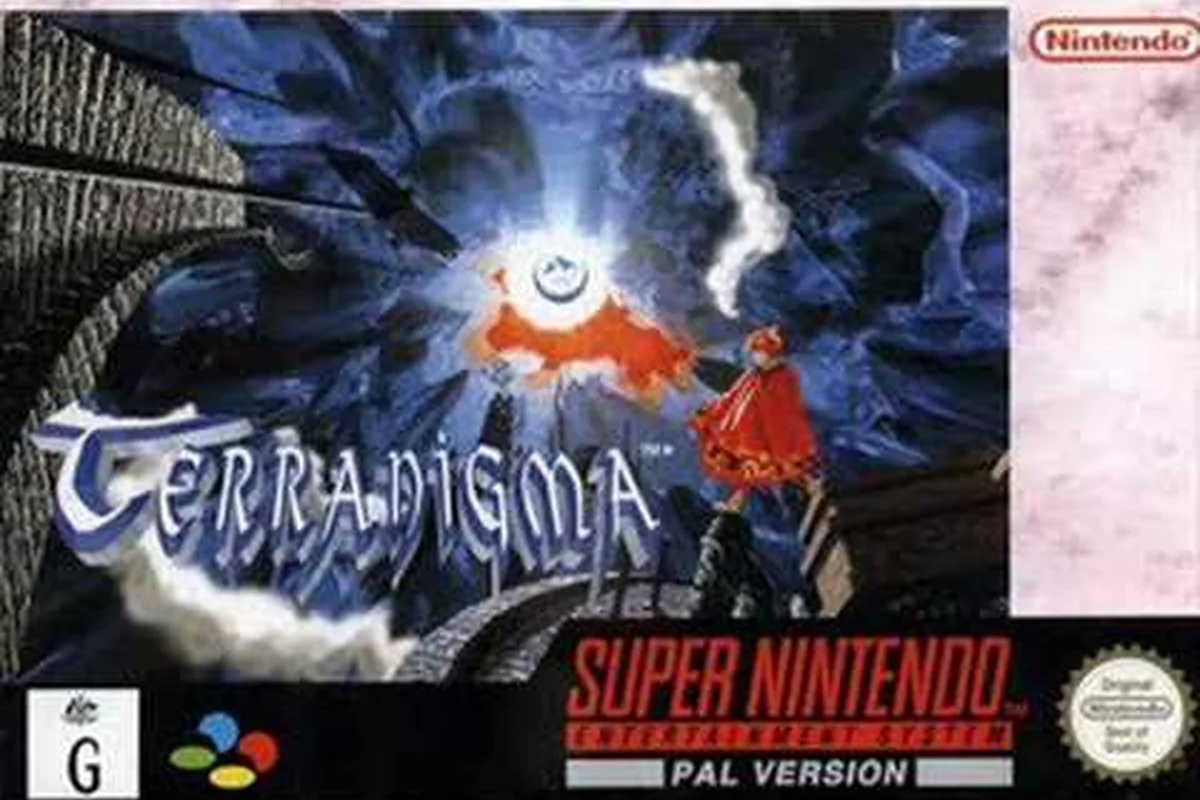
Yomi is not just a random boss or a one-dimensional villain in Terranigma. He is the pivot point for the entire narrative, and understanding his connection to Dark Gaia transforms how you read every story beat after Crysta. This Terranigma Yomi guide breaks down the character's dual role as comic companion and cosmic antagonist, the underworld's function as a testing ground, and the Light Gaia conflict that gives the ending its weight. Because the Light Gaia conflict only lands when you understand the opposing cosmic force, a full breakdown of the game’s other primal entity is available in our Terranigma Dark Gaia Guide, which details how the destructive counterpart shapes both the underworld’s trials and the final act’s stakes.
Yomi Character Profile and Narrative Function
Yomi occupies a strange narrative position in Terranigma. When Ark first opens the forbidden door in Crysta, Yomi appears as a demonic entity, but the game quickly pivots his presentation into something closer to a traveling trickster. He follows Ark through much of the resurrection journey, offering sarcastic commentary and occasional gameplay-relevant hints. This tonal shift is deliberate, because it prevents players from immediately categorizing Yomi as a straightforward antagonist.
The character's power structure deserves close analysis. Yomi is not a self-contained villain; he functions as an agent or fragment of Dark Gaia, the planetary will that governs the Darkside of the world. The Steam store description for the re-release emphasizes the planet as a hollow sphere with an external Lightside and internal Darkside, which frames Yomi's role as the internal world's representative in Ark's surface journey. Community discussions on the Steam hub and subreddit consistently treat Yomi as a narrative device that forces Ark to confront what resurrection actually costs.
| Narrative Phase | Yomi's Role | Player Perception Shift |
|---|---|---|
| Crysta Opening | Released demon, immediate threat | Antagonist / danger source |
| Resurrection Journey | Sarcastic guide, comic relief | Ambiguous ally / observer |
| Late-Game Reveal | Agent of Dark Gaia, truth-teller | Cosmic antagonist with valid grievance |
| Final Conflict | Direct obstacle or test | Sympathetic but oppositional |
What makes Yomi memorable is that he never lies to Ark outright. He withholds, mocks, and manipulates, but his statements about the planet's dual nature hold up under scrutiny. According to player consensus on r/Terranigma, the late-game conversations with Yomi recontextualize earlier jokes as warnings, which rewards replays and careful attention to dialogue.
Yomi's Relationship to Ark and Elle
The triangle between Ark, Elle, and Yomi is not romantic in the traditional sense, but it is emotionally loaded. Elle represents the human cost of resurrection, while Yomi represents the planetary cost. Ark stands between them, unable to satisfy either fully. This structural tension is why the ending resonates, because neither Dark Gaia nor Light Gaia is framed as purely evil or purely benevolent.
Yomi's commentary on Elle is particularly sharp in the middle chapters. He frequently dismisses Ark's emotional attachments as temporary surface-world concerns, which reads as cruelty until the player understands that Yomi operates on geological timescales. For a being connected to planetary will, human lifespans are negligible, and the game does not soften this perspective.
Dark Gaia and Light Gaia: The Core Dualism
To explain Dark Gaia properly, you have to understand that Terranigma's theology is not a simple good-versus-evil binary. Light Gaia governs the surface world, the realm of growth, life, and external creation. Dark Gaia governs the underworld, the realm of dormancy, return, and internal balance. Neither can exist without the other, because the planet is a closed system.
The official Steam page describes the Earth as a hollow sphere, with an external Lightside and an internal Darkside. This is not flavor text; it is the mechanical and narrative foundation for the entire game. Ark begins in Crysta on the Darkside, moves to the Lightside to resurrect continents and life, and then must return to the Darkside to resolve the conflict he helped create. The terranigma gaia lore explained through this journey is that creation and destruction are phases, not opposites.
| Aspect | Light Gaia (Lightside) | Dark Gaia (Darkside) |
|---|---|---|
| Domain | Surface world, external sphere | Underworld, internal sphere |
| Function | Growth, life, expansion | Dormancy, return, balance |
| Representative | Ark's resurrection mission | Yomi, the underworld's agent |
| Threat If Unbalanced | Overgrowth, unchecked creation | Entropy, dissolution |
| Player Alignment | Early and mid-game focus | Late-game confrontation |
The key insight is that Ark's resurrection of the surface world disrupts a pre-existing equilibrium. Dark Gaia does not attack out of malice but out of systemic correction. The game hints at this through environmental storytelling: the more Ark revives, the more the underworld seems to stir. Community interpretations on the subreddit vary, but the most coherent reading treats Yomi's antagonism as a response to Ark's unilateral action.
Why the Underworld Is Not Hell
The terranigma underworld explained in the game's own terms is closer to a root system than a punishment realm. It is where souls and energies return, where the planet's internal processes continue unseen. Calling it a hell or demon realm misunderstands the cosmology. The underworld is the planet's interior, the Darkside, and its inhabitants are not evil but functionally different.
This distinction matters for understanding Yomi. If the underworld were simply evil, Yomi would be a demon in the conventional sense. Instead, he is a complex figure whose hostility stems from a legitimate cosmic grievance. The game trusts the player to grasp this without heavy-handed exposition, which is part of why the story still holds up decades later.
The Underworld's Role in Terranigma's Story Structure
The underworld functions as both a literal location and a narrative counterweight. Ark's journey from Crysta to the surface is an ascent, but the story's emotional arc is a descent into consequence. The underworld sections, particularly the late-game return, force Ark to confront what his resurrection mission has actually cost the planet's internal balance.
The structure mirrors classic mythic patterns without being derivative. Ark descends to the underworld not to rescue a single soul but to resolve a systemic imbalance. This is why the terranigma yomi character explained material is inseparable from the underworld itself; Yomi is the underworld's voice, its interpreter, and ultimately its champion.
| Story Phase | Location | Underworld Significance |
|---|---|---|
| Opening | Crysta (Darkside village) | Origin point, forbidden door |
| Resurrection | Surface world | Underworld dormant but watching |
| Beruga Conflict | Civilized surface | Underworld imbalance worsens |
| Final Descent | Darkside interior | Direct confrontation with Dark Gaia |
| Resolution | Cosmic / planetary scale | Balance restored or redefined |
The game's pacing places the underworld return late enough that players have formed attachments to the surface world. This makes the return feel like a sacrifice, which is precisely the intended emotional effect. Yomi's taunts during earlier chapters retroactively become warnings that the surface world's flourishing is not free.
The Forbidden Door and Yomi's Release
Ark's decision to open the forbidden door in Crysta is the inciting incident for everything that follows. The elder of Crysta warns against it, but the game frames Ark's curiosity as inevitable rather than merely reckless. Yomi's release is the consequence, and the game does not allow the player to avoid it.
This moment is crucial for understanding Dark Gaia in the narrative. The forbidden door is not simply a prison for a demon; it is a seal between the Lightside and Darkside functions. By opening it, Ark initiates the planetary process that will eventually require the full resurrection journey. Yomi is the catalyst, not the cause, of the imbalance.
Terranigma Gaia Lore: Cosmology and Consequence
The terranigma gaia lore explained through the game's cosmology is that the planet is a living system with two governing wills. Neither will is fully accessible to human understanding, and both operate on timescales that dwarf individual lives. Ark's story is the rare moment when a human-level actor becomes entangled in planetary-level processes.
This cosmology sets Terranigma apart from simpler RPG narratives where the hero defeats a dark lord and restores peace. The game's ending, which the subreddit discusses extensively, resists easy resolution. Depending on interpretation, Ark's final act either merges the two wills, dissolves himself into the planetary system, or achieves a temporary balance that will eventually require another intervention. The ambiguity is intentional.
| Cosmological Element | Game Function | Narrative Implication |
|---|---|---|
| Hollow Planet | Spatial metaphor for dualism | Interior and exterior are both necessary |
| Light Gaia | Surface governance | Growth without balance leads to collapse |
| Dark Gaia | Underworld governance | Dormancy without growth leads to stasis |
| Resurrection Towers | Player-driven creation | Creation disrupts existing equilibrium |
| Forbidden Door | Seal between realms | Human action triggers planetary process |
| Yomi | Dark Gaia's agent | Voice of the internal world |
What the game does not do is provide a clean moral. Light Gaia is not the good god and Dark Gaia is not the evil one. Both are necessary, and Ark's tragedy is that he is forced to act within a system that cannot accommodate his attachments. This is mature storytelling, and it is why the game's cult reputation persists.
Beruga and the Human Counterpoint to Gaia
Beruga serves as the human-world antagonist, and his presence complicates the Gaia dualism. Where Dark Gaia represents planetary balance, Beruga represents human ambition divorced from ecological consequence. The Asmodeus virus, which Beruga unleashes, is a surface-world catastrophe that has nothing to do with the underworld.
This three-way conflict—Ark, Yomi/Dark Gaia, and Beruga—prevents the story from reducing to a simple two-sided war. Ark must deal with Beruga's human-scale villainy while also reckoning with Yomi's cosmic-scale opposition. The game suggests that both threats stem from the same root: imbalance, whether ecological or spiritual.
Interpreting Yomi's Final Role and the Ending
The ending of Terranigma is deliberately open, and Yomi's final role is central to every major interpretation. In the most widely accepted reading, Yomi is not defeated so much as integrated. Ark's final act acknowledges that Dark Gaia and Light Gaia are not enemies but complementary functions of a single planetary system.
Community interpretations on r/Terranigma vary significantly. Some players read the ending as tragic, with Ark sacrificing his individual existence for planetary balance. Others read it as transcendent, with Ark becoming part of the system he helped restore. A smaller group reads it as cyclical, suggesting that the balance is temporary and another Ark will eventually be needed. Yomi's final dialogue supports the cyclical reading, because he speaks as though the conflict is eternal rather than concluded.
| Interpretation | Yomi's Final Role | Emotional Tone |
|---|---|---|
| Tragic Sacrifice | Opponent who forces Ark's dissolution | Melancholic |
| Transcendent Unity | Adversary who becomes integrated | Bittersweet |
| Cyclical Return | Eternal counterpart to Ark's role | Existential |
| Ecological Balance | Representative of necessary decay | Resigned / Accepting |
What unites these interpretations is the recognition that Yomi is not a villain to be defeated in the conventional sense. He is a force that must be reckoned with, and Ark's victory, if it can be called that, is the achievement of understanding rather than conquest.
Why Yomi Resonates with Players
The terranigma yomi guide material resonates because it refuses to simplify. Yomi is funny, cruel, wise, and pitiable in turns. He is the rare antagonist who is also a companion, and his tonal shifts mirror the game's larger movement between surface brightness and underworld depth.
Players on the Steam community hub frequently cite Yomi as a highlight of the narrative, often alongside the Bloody Mary difficulty wall as a memorable moment. The character works because the game earns his complexity through dozens of small dialogue exchanges rather than a single dramatic reveal. By the time Yomi's true nature becomes clear, the player has spent hours with him and cannot dismiss him as a simple monster.
Frequently Asked Questions
What is the Terranigma Yomi guide actually about?
The Terranigma Yomi guide explains Yomi's dual role as comic companion and agent of Dark Gaia, his connection to the underworld, and how his conflict with Light Gaia drives the game's ending. It provides a character analysis grounded in the game's cosmology rather than a simple walkthrough.
Is Yomi a villain or an ally in Terranigma?
Yomi is both, and neither label fully captures his function. He begins as a released demon, becomes a sarcastic traveling companion, and ends as an agent of Dark Gaia. The game deliberately blurs the line, because Yomi represents planetary balance rather than personal malice.
What is the difference between Dark Gaia and Light Gaia?
Light Gaia governs the surface world and external growth, while Dark Gaia governs the underworld and internal balance. Neither is evil; both are necessary functions of the hollow planet. Ark's resurrection mission disrupts their equilibrium, which triggers the late-game conflict.
Why does Ark open the forbidden door in Crysta?
Ark opens the forbidden door out of curiosity and a desire to understand what the elder of Crysta is hiding. This act releases Yomi and initiates the planetary process that drives the entire story. The game frames the act as inevitable rather than merely reckless.
What happens to Yomi at the end of Terranigma?
The ending is deliberately ambiguous, but most interpretations agree that Yomi is not simply defeated. Ark either integrates Yomi's function, dissolves into the planetary system, or achieves a temporary balance that may eventually require another intervention. Yomi's final dialogue supports the cyclical reading.